Showing posts with label Economics. Show all posts
Showing posts with label Economics. Show all posts

BBC Vietnamese - Kinh tế VN: ‘Càng tăng trưởng càng nghèo
Labels: Economics, Vietnam |From: BBC Vietnamese
Ông Trần Xuân Giá, cựu Bộ trưởng Kế Hoạch Đầu tư tỏ ý quan ngại về cách điều hành kinh tế tại Việt Nam.
Trên bài phỏng vấn đăng trên Thời báo Kinh tế Việt Nam, cựu quan chức chính phủ, từng điều hành một trong những bộ quan trọng nhất nước, nhận định: “Cả tư duy và mô hình tăng trưởng hiện nay đã không còn phù hợp."
“Chúng ta không thể tiếp tục tư duy tăng trưởng theo lượng, khuếch đại, sùng bái con số và che đậy các khuyết điểm của nền kinh tế được nữa,” ông Trần Xuân Giá nói.
“Nếu không, càng tăng trưởng, có thể chúng ta sẽ càng nghèo đi.”
Một số trí thức trong nước đã từng quan tâm đến chủ đề này. Ông Nguyễn Trần Bạt, Giám đốc Công ty Tư vấn Đầu tư InvestConsult cho hay nhiều năm trước ông đã quan ngại đến cách làm kinh tế tại Việt Nam.
"Tôi đã nói điều này cách đây 10 năm. Trong một số bài báo, tôi cảnh báo tâm lý tăng trưởng bằng mọi giá. Tôi viết từ rất sớm. Hiện nay nó đẻ ra một cái thực tế mà (cựu) bộ trưởng phải lên tiếng. Chúng tôi, với tư cách là người trí thức bình thường, đã từng lên tiếng trước đó, cảnh báo trước đó, không chỉ cho Việt Nam. Mà cho tất cả các quốc gia kiểu Việt Nam.”
Trong bài phỏng vấn đăng trên tuần báo kinh tế có uy tín từ Hà Nội, ông Trần Xuân Giá tự xếp mình vào nhóm những người bi quan về kinh tế Việt Nam.
Bi quan
Chúng ta không thể tiếp tục tư duy tăng trưởng theo lượng, khuếch đại, sùng bái con số và che đậy các khuyết điểm của nền kinh tế được nữa
Trần Xuân Giá - Cựu Bộ trưởng KH và ĐT
Bên cạnh thừa nhận một số thành tích như, “năm 2009 không rơi vào suy thoái, ngăn chặn được nguy cơ phá sản ở nhiều doanh nghiệp, kiểm soát được lạm phát ở mức 6,88%,” vân vân, cựu quan chức chính phủ nói đến một số lĩnh vực Việt Nam đang phải trả giá.
Đó là “sự phục hồi của kinh tế Việt Nam diễn ra không đồng đều, chưa vững chắc, tạo nên bức tranh sáng tối lẫn lộn.”
Các khó khăn đang tiềm ẩn trong kinh tế Việt Nam, theo ông Trần Xuân Giá, là tỷ giá hối đoái, và lạm phát; chi tiêu công gia tăng; nhập siêu sẽ tăng do giá nguyên liệu trên thế giới tăng, môi trường bị phá hoại nặng nề.
Trước một số ý kiến nhắc đến cuộc khủng hoảng tài chính thế giới như là nguyên nhân khiến cho kinh tế Việt Nam chao đảo trong năm 2008, ông Trần Xuân Giá chỉ ra, ngay cả trước thời kỳ khủng hoảng (2007 cho đến trước quý 3/2008) Việt Nam đã bộc lộ nhiều khó khăn.
“Nguyên nhân suy giảm của kinh tế Việt Nam không chỉ đến từ bên ngoài. Quan trọng nhất là những nguyên nhân nội tại. Nền kinh tế Việt Nam khi ấy gặp không ít khó khăn.
“Lạm phát cao, nhập siêu lớn. Những yếu kém cơ bản đó nằm ngay trong cả cơ cấu lẫn cơ chế kinh tế của Việt Nam.”
Cựu bộ trưởng, hiện tham gia điều hành hội đồng quản trị của ngân hàng ACB, sau đó liệt kê những thiếu sót cơ bản của kinh tế trong nước.
“GDP tăng chủ yếu dựa vào vốn đầu tư nhưng hiệu quả đầu tư ngày càng kém, năng suất lao động thấp, chi phí sản xuất, tiêu hao năng lượng trên một đơn vị sản phẩm tăng cao,
"Công nghệ chậm đổi mới, cơ cấu kinh tế, cơ cấu xuất khẩu chưa thoát khỏi lạc hậu, thị trường trong nước kém phát triển, kinh tế vĩ mô còn nhiều yếu tố bấp bênh, tiềm ẩn nguy cơ lạm phát cao, môi trường cạnh tranh chưa bình đẳng, lành mạnh.”
Ông Nguyễn Trần Bạt từ công ty InvestConsult lo ngại lối tăng trưởng kiểu “sùng bái con số’’ sẽ đưa Việt Nam đến một kết cục không hay.
“Ăn kẹo mãi thì sẽ bội thực đường. Giấy kẹo nó rơi xuống chân mình nó cao đến mức nó làm tắc thở cái người ngồi, hoặc đứng ăn kẹo.
“Cho nên là tăng trưởng theo kiểu như thế này chính là một trong những biện pháp giết chết một cách chắn chắn nhất tương lai, không chỉ tương lai kinh tế, mà nhiều tương lai khác của Việt Nam.”
Outlook for 2010: How strong a recovery?
Labels: Economics |Vanguard 01/22/2010
Heading into a new year, the economy seems to be mending after a long recession. Can the recovery stay on track? And how strong will it be?
In Vanguard's latest analysis, chief economist Joseph H. Davis, Ph.D., discusses the outlook for 2010, including his perspectives on U.S. interest rates and the strong growth in emerging markets.
Visualizing Vietnam Economy 2009
Labels: Economics, Vietnam |This is the first version.
There will be more to come.

Vietnam Catch-up points with Rule of 70
Labels: Economics, Vietnam |
Applying the Rule of 70, which states that the number of years it takes for the level of any variable to double is approximately 70 divided by the annual percentage growth rate of the variable (CFA, 2009), to answer the question: "how long would it take Vietnam's real GDP per person to reach that of America in 2008?"
Assuming that Vietnam will continue to grow at speed of 7%, with 2008 GDP per capita of Vietnam is 16 times less than that of the US. According to rule of 70, Vietnam's GDP per person doubles in 10 years (70 divided by 7); it doubles again to 4 times its current level in another 10 years, again to 8 times in another 10 years, and again to 16 times. So after 40 years of growth at 7% a year, Vietnam's real GDP per person is 16 times its current level and equals that of America (CFA, 2009)
From: Snippets.com

Capitalism, Market-oriented Economy & Kinh Tế Thị Trường
Labels: Capitalism, Economics, Quotes, Vietnam |From: phapluattp.vn
"Muốn sánh vai cường quốc, phải phát triển kinh tế thị trường"
"Cuối thế kỷ XX, kinh tế thị trường chuyển sang mô hình mới là kinh tế thị trường hiện đại. Đây là mô hình dựa trên nền tảng khoa học công nghệ tiên tiến, kết hợp hài hòa giữa bốn yếu tố: thị trường – nhà nước pháp quyền – xã hội dân sự – hội nhập quốc tế sâu rộng. Mục tiêu chung mà nền kinh tế hiện đại hướng đến là sự hưng thịnh của quốc gia, dân tộc, sự giàu có của người dân và sự bình đẳng giữa con người." _ GS-TSKH Lê Du Phong
“Từ góc nhìn vận động của lịch sử, có thể nhận thấy bản chất kinh tế thị trường nhất định đi đến một xã hội tương lai. đó là xã hội mang bản chất nhân văn, xã hội của sự phát triển tự do và toàn diện của cá nhân mỗi người, xã hội phát triển trong quan hệ hài hòa giữa con người với con người và con người với tự nhiên sau một quá trình lịch sử đầy máu và nước mắt” _ GS Trần Ngọc Hiên
1 Year After The Falls - Part III: Spending
Labels: Economics, Finance |From: valuestockplus.net


Headlines:
- Retail Sales rise 2.7% in August - Sep 15, 2009 | money.cnn.com
- Retail Sales rise beyond expectations - Sep 15, 2009 | cbsnews.com
- Retail Sales increase by largest amount in 3 years - Sep 15, 2009 | blog's carpediem
Opinion: With 70% of GDP is PCE (personal consumption expenditures) Uncle Sam's health is tied to American's spending; signal by retail sales which has been reported as good number. The more consumers get back to markets, the bigger uncle sam's pocket. Retail Sales reflects the current state of the economy, meanwhile, serves as predictor of inflation. Thus, the high-jump figure would trigger the action of Fed in tightening monetary policy (hike rate and shrink money). Time of Crisis has past, now comes Era of Inflation (as a friend of Growth).
Again, chart with FusionCharts using data from BEA
1 Year After The Falls - Part II: Wealth
Labels: Economics, Finance |Special Report: The Crisis - 1 Year Later
...and unique special report, CNBC uncovers the truth behind the crisis all the way back its roots in 2001, and how greed brought the global financial system to its knees...

Headlines:

- US net worth grew in 2Q for first time since '07 - Seattlepi.com | Sep 17, 09
- US economy: home starts, manufacturing index rise - Bloomberg.com | Sep 17, 09
- US household net worth up 3.9% to $53.1 trillion in 2Q - Nasdaq.com | Sep 18, 09
- Bernanke: Recession "likely over" - WSJ.com | Sep 16, 09
Opinion: Thanks to rising of equity plus housing markets and learning of savings (not spending by credit debt), people's vaults are getting bigger. And the simple truth: the more money earned, the more money spent; which in turn would create the wealth to the nation. Remember this: "By pursuing his own interest he frequently promotes that of the society more effectually than when he really intends to promote it - Adam Smith."
Chart with Fusioncharts:
Banking Report
Labels: Bank, Economics |FDIC State Profiles
Second Quarter 2009
"Effective January 2007, FDIC State Profiles have been reformatted as a quarterly data sheet summation of banking and economic conditions in each state..."

Quick Facts from FDIC.gov:
- CA:
- Unemployment rate: 11.4% vs. 6.8% (Q2/2008)
- Home price index: -12.6% vs. -17.3% (Q2/2008)
- Nonbusiness Bankruptcy Filings per 1000 people: 5.53 vs. 3.36 (Q2/2008)
- NY:
- Unemployment rate: 8.2% vs. 5.2% (Q2/2008)
- Home price index: -4.1% vs. -1.2% (Q2/2008)
- Nonbusiness Bankruptcy Filings per 1000 people: 3.04 vs. 2.47 (Q2/2008)
Heading of Economics: Gold and Inflation
Labels: Economics, Inflation |Gold Jumps to 18-Month High on Weaker Dollar, Inflation Outlook
By: Nicholas Larkin, Halia Pavliva and Kim Kyoungwha
“The market thinks inflation is coming,” Leonard Kaplan, the president of Prospector Asset Management in Evanston, Illinois, said by telephone. He has been trading gold for more than 30 years and believes gold won’t stay above $1,000 for long. “With interest rates so low, money is chasing money and the dollar is getting murdered.”
Governments have cut interest rates and boosted spending to fight the worst recession since World War II, spurring investors to buy bullion as a hedge against the prospect of accelerating inflation and currency debasement. Gold, silver and palladium holdings in exchange-traded funds have reached records.
$1,200 ‘Possible’
Gold may set a record within five sessions and “it’s possible” that it will touch $1,200 within weeks, Prospector’s Kaplan said. “And if a new record doesn’t come soon, it doesn’t come in the near future,” Kaplan said. “Markets think that the Fed isn’t going to withdraw stimulus money fast enough and that would cause inflation.”
Oil Climbs
Crude-oil futures, used by some investors to forecast inflation, surged as much as 5.5 percent today and have soared 59 percent this year in New York.
From: Telegraph
China, Bernanke, and the price of gold
“If they keep printing money to buy bonds it will lead to inflation, and after a year or two the dollar will fall hard. Most of our foreign reserves are in US bonds and this is very difficult to change, so we will diversify incremental reserves into euros, yen, and other currencies,” he said.
From: The Economist
World economyU, V or W for recovery
Aug 20th 2009
The world economy has stopped shrinking. That’s the end of the good newsIT HAS been deep and nasty. But the worst global recession since the 1930s may be over. Led by China, Asia’s emerging economies have revived fastest, with several expanding at annualised rates of more than 10% in the second quarter. A few big rich economies also returned to growth, albeit far more modestly, between April and June. Japan’s output rose at an annualised pace of 3.7%, and both Germany and France notched up annualised growth rates of just over 1%. In America the housing market has shown signs of stabilising, the pace of job losses is slowing and the vast majority of forecasters expect output to expand between July and September. Most economies are still a lot smaller than they were a year ago. On a quarterly basis, though, they are turning the corner.
A History of Amarican Growth
Labels: America, Economics |Tuesday July 28th 2009

Dropping the shopping
Can America wean itself off consumption? The first of a series on how the world’s four biggest economies must change to ensure sustainable global growth
"For decades, its growth has been led by consumer spending. Thanks to rising asset prices and ever easier access to credit, Americans went on a seemingly unstoppable spending binge, fuelling the global economy as they bought ever bigger houses and filled them with ever more stuff. Consumer spending and residential investment rose from 67% of GDP in 1980 to 75% in 2007. The household saving rate fell from 10% of disposable income in 1980 to close to zero in 2007; household indebtedness raced from 67% of disposable income to 132%. As Americans spent more than they produced, the country’s current-account balance went from a surplus of 0.4% of GDP in 1980 to a deficit of almost 6% in 2006..."
5 reasons it's too soon to declare the recession over
Labels: Economics |Posted by: Peter Coy on July 15
From: BusinessWeek
1. UNEMPLOYMENT: Consumers won’t start shopping again in earnest as long as the unemployment rate is at 9.5% and threatening to break into double digits. People who are out of work can’t spend, and people who fear being out of work won’t spend.

Chart: Econoday


Chart: Econoday

2. SPARE CAPACITY: Companies won’t hire or buy equipment as long as they have lots of slack. Today’s industrial production report revealed that the U.S. industrial capacity utilization rate fell in June to 68%, the lowest since recordkeeping began in 1967. World Bank Chief Economist Justin Lin said today in South Africa that unless global overcapacity is reduced, “we will face a deflationary spiral and the crisis will become protracted,” according to Bloomberg.

Chart: Econoday
3. DEBT: As I’ve written, household debt soared from two-thirds of GDP in the early 1990s to 100% at the end of 2008. Simply getting debt back to three-quarters of GDP, the level of 2001, would require paying off 25% of all outstanding household debt, $3.5 trillion worth. Paying down debt gets even harder when GDP is falling—that’s Keynes’s paradox of thrift.
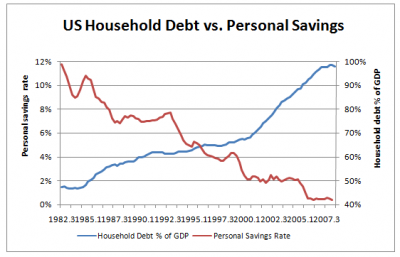
Chart: SeekingAlpha
4. BOND VIGILANTES: If fixed-income investors get nervous that the government’s massive deficit spending will push up inflation, they will sell bonds and drive up interest rates. That would be a huge setback for homebuying, car sales, and other rate-sensitive sectors.

Chart: Econoday
5. DOUBLE DIP: Even if the gross domestic product rises in the current July-September quarter—and it might—output could very well fall again in the fourth as the effects of the stimulus tax cuts begin to fade.

Chart: BBC
"Where Are We Now? Five Point Summary"
Labels: Economics, Finance |From: The Baseline Scenario
"1. Financial markets have stabilized – largely because people believe that the government will not allow Citigroup to fail...
2. The real economy begins to bottom out, although unemployment will not peak for a while and could stay high for several years...
3. More broadly, there is sophisticated window dressing in the pipeline but no real reform on any issue central to (a) how the banking system operates, or (b) more broadly, how hubris in finance led us into this crisis...
4. The consensus from conventional macroeconomics is that there can’t be significant inflation with unemployment so high, and the Fed will not tighten before late 2010...
5. Emerging markets are increasingly viewed as having “decoupled” from the US/European malaise...
Avoiding the middle-income trap: renovating industrial policy formulation in Vietnam
Labels: Economics, Vietnam |Publication: ASEAN Economic Bulletin
Publication Date: 01 April, 09
Author: Ohno, KenichiHtml: AccessMyLibrary.com
Pdf: Viet-studies.info
Slide: Grips.ac.jp
"Vietnam’s growth in the last one-and-half decades has been driven by the liberalization effect and large inflows of external purchasing power. Now that the processes of systemic transition and global integration have deepened, Vietnam needs to create internal value to continue to grow and avoid the “middle-income trap”. The country has reached the point where growth towards higher income cannot be secured unless policy making is renovated significantly to activate the country’s full potential. The vision of Industrialization and Modernization to be achieved by 2020 must be backed by realistic industrial strategies and concrete action plans, which are currently lacking. Stakeholder involvement in policy design, inter-ministerial coordination, clear directives from the top, and incentive structure for government officials must be improved. This in turn calls for radical changes in policy administration. A new style of leadership, a technocrat team directly serving the top leader, and strategic alliance with international partners are proposed as key entry points for the renovation of Vietnam’s industrial policy formulation."


Subscribe to:
Posts (Atom)